.svg)


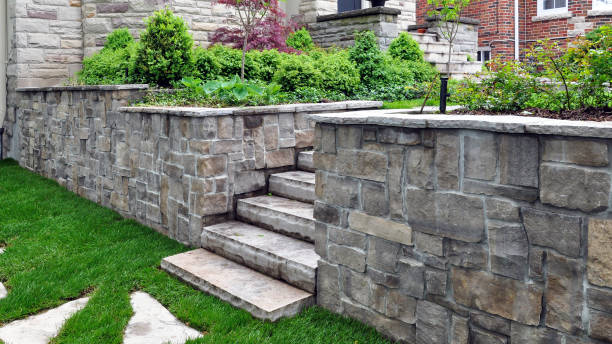
Retaining walls are one of the most functional and visually impactful structures you can add to a residential property in North Texas. They solve real problems — erosion, sloped yards, poor drainage, and unusable terrain — while simultaneously creating structure, definition, and beauty in the landscape. But they're also structures that fail when they're not designed and built correctly, and in DFW's challenging clay soil environment, getting the details right matters enormously.
If you're considering a retaining wall for your DFW property, this guide walks you through everything you need to know — from material options and design considerations to what proper installation involves and how to recognize quality workmanship.
What Retaining Walls Are Actually Doing
A retaining wall holds back a mass of soil on one side while creating a level or usable surface on the other. The wall resists the lateral pressure of the retained soil — and in DFW, that means resisting not just the weight of dry soil but the dramatically increased pressure of saturated, expanded clay soil after heavy rain events.
This is why retaining walls in North Texas fail more often than in other regions when they're not properly engineered. DFW's expansive clay soil can exert enormous lateral force against a wall, and without proper drainage to relieve hydrostatic pressure and proper structural design to handle the load, even a well-built-looking wall will eventually bow, crack, or overturn.
Retaining Wall Materials Popular in DFW
Concrete Block is the most widely used retaining wall material in DFW residential applications. Engineered retaining wall blocks — brands like Allan Block and Versa-Lok — are specifically designed for structural performance. They have a built-in batter angle that leans back into the slope for stability, and they interlock in patterns that provide significant lateral strength. Concrete block walls are available in a wide range of colors and textures that complement virtually any home style.
Natural Limestone is a material with deep roots in Texas landscape construction. Limestone is abundant in the region, has a warm, natural aesthetic, and produces walls that look like they belong in the landscape. Dry-stacked limestone walls have a rustic, organic appearance, while mortared limestone walls can be built to a more formal, refined standard. For homeowners who want a wall that looks naturally at home in a Texas landscape, limestone is hard to beat.
Austin Stone is a specific type of cut limestone quarried in Central Texas that's become a signature material in DFW and throughout North Texas. Austin stone has a distinctive warm cream-to-buff color tone and a clean, handsome appearance that works beautifully in both traditional and contemporary landscape settings.
Brick complements traditional home styles and creates a formal, structured wall appearance. Brick retaining walls work best at lower heights and in landscape settings where the formal aesthetic is appropriate.
Poured Concrete and Concrete Block with Stucco Finish are options for walls that need maximum structural strength or a smooth, modern aesthetic. These are more common in commercial applications but are used in residential settings for larger walls or contemporary design projects.
The Critical Role of Drainage in DFW Retaining Walls
Drainage is the single most important factor in retaining wall longevity in North Texas — and it's the factor most commonly skipped or inadequately addressed in poor-quality installations. When water saturates the clay soil behind a retaining wall and has nowhere to go, it builds hydrostatic pressure against the back of the wall. Over time, that pressure will move even a solidly built wall.
A properly drained retaining wall in DFW includes a crushed gravel drainage layer directly behind the wall that allows water to move freely, a perforated drain pipe at the base of the drainage layer to collect and redirect that water, and weep holes through the wall face at regular intervals to allow any water that does build up to escape. These drainage elements are not optional — they're fundamental to building a retaining wall that will still be standing and performing correctly in 20 years.
How Retaining Walls Transform Usable Space
Beyond their structural function, retaining walls are one of the most powerful tools for creating usable outdoor space on challenging terrain. A sloped backyard that's difficult to mow, nearly impossible to use for outdoor living, and prone to erosion becomes a series of functional terraced areas when retaining walls are used to manage the grade change.
Terraced retaining walls can create a flat patio area at one level, raised garden beds at another level, and a lawn area at a third level — turning what was wasted slope into genuinely livable outdoor space. Many of Broadstone Landscape's most dramatic project transformations involve properties where retaining walls turned difficult terrain into beautiful, functional outdoor environments.
Broadstone Landscape Retaining Wall Services in DFW
At Broadstone Landscape, retaining wall design and construction is one of our core specialties. Our in-house crews are experienced with the full range of retaining wall materials and with the specific structural and drainage requirements of DFW's clay soil environment. We design walls that are built to last — properly drained, correctly battered, and constructed with the craftsmanship that produces results our clients are genuinely proud of.

.svg)


.svg)